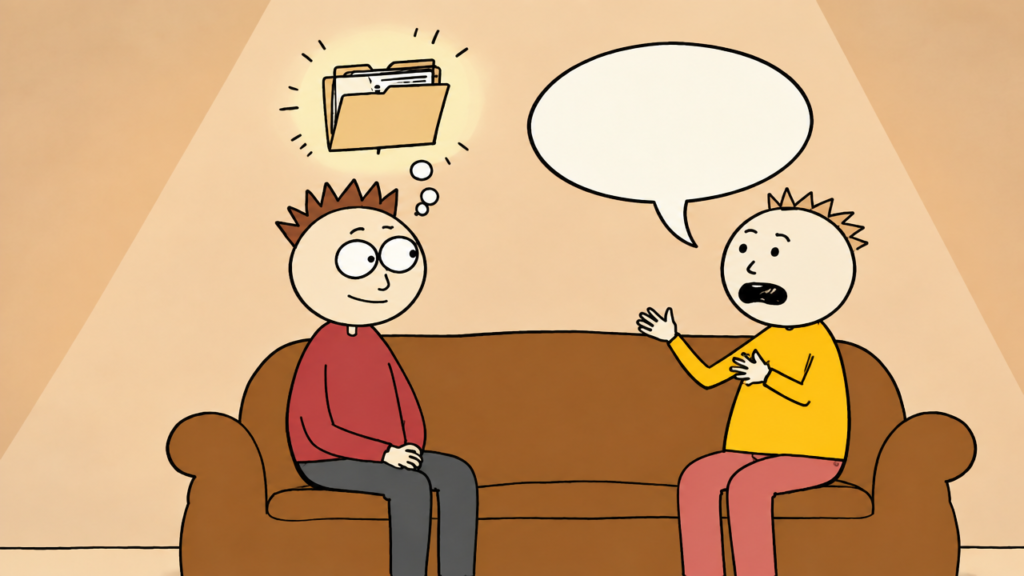
He’s nodding. He’s polite. He might even be smiling.
But somewhere behind his eyes, a file is being updated — and you just added a line to it.
If you’ve ever sat across from an INTJ and felt quietly measured, you weren’t imagining it. Most people read that stillness as arrogance, as though he’s sitting there deciding he’s smarter than everyone in the room. That’s the misread, and it’s the one that costs people the relationship before it starts.
He isn’t ranking you. He’s reading you.
Table of Contents
First: the J in INTJ literally stands for judging
This isn’t a metaphor. It’s written into the name of the type.
In Carl Jung’s model of personality, “judging” doesn’t mean criticizing. It means deciding — sorting the world into what works and what doesn’t, what’s true and what isn’t. For the INTJ, that sorting runs through extraverted thinking, paired with introverted intuition: a mind that quietly builds models of how things are going to unfold.
Put those together and you get someone who is always, silently, testing whether reality matches his predictions. Including his predictions about you.
You see it in small things. The pause before he answers. The way he remembers something you said eight months ago, word for word. The friend he quietly stopped calling, without a fight, without an argument, without ever explaining why.
None of it is personal. All of it is data.
Here are the seven kinds of data he weighs most heavily — and what each one is actually measuring.
1. Agreeing with him too easily
You’d think an INTJ would love being agreed with. He doesn’t. Fast agreement makes him trust you less.
In the 1970s, psychologist Irving Janis studied some of the worst decisions in modern history and found a pattern he named groupthink: smart people, in rooms full of other smart people, making disastrous choices because nobody wanted to be the one who disagreed. Harmony mattered more than accuracy. The Bay of Pigs invasion was one of his case studies — advisors who privately doubted the plan said nothing in the meeting.
An INTJ’s thinking style is built to fight exactly that. To him, an idea nobody has pushed against hasn’t been tested yet, and agreement with no friction carries no information at all.
So when you nod along to everything he says, he doesn’t feel supported. He feels alone — because now he has no idea whether his thinking is actually any good.
What earns him instead: “I think you’re wrong, and here’s why.” Not because he enjoys conflict, but because you’ve just proved your yes means something.
2. Asking questions you could have answered yourself
Not hard questions. He loves hard questions. The ones where ten seconds of effort would have gotten you there.
Psychologists Susan Fiske and Shelley Taylor described people as cognitive misers: the brain is lazy by design, and given the choice it spends the least effort it can get away with. Most people accept that about each other. The INTJ can’t, because he’s spent his whole life doing the opposite — reading the manual, checking the source, working it out before he opens his mouth.
So when you hand him a question you never tried to solve, what he hears isn’t curiosity. He hears: I’d rather spend your energy than mine.
Here’s the part people miss. He’ll still answer. Patiently, usually. But he’s quietly adjusting how much he’ll invest in you next time.
What earns him instead: “I tried this and this, and I’m stuck right here.” Watch his whole posture change. Effort first, then help.
3. The small promises you break
Not the big ones. The small ones. I’ll text you tonight. I’ll send that over tomorrow. The things you forgot the second you said them.
To most people that’s nothing — life gets busy. But the INTJ isn’t watching the promise. He’s watching the pattern.
Psychologist Walter Mischel found that people aren’t consistent across every situation, but they are remarkably consistent within the same kind of situation. He called these if-then signatures. If you’re rushed, then you cut corners. If it’s inconvenient, then you disappear. Those patterns are stable, and they predict behavior.
That’s exactly what an INTJ’s intuition is built to detect. A small broken promise is a free preview of what you’ll do when something big is on the line. It’s the cheapest test there is, and you don’t even know you’re taking it.
It’s also more forgiving than it sounds. One slip, he forgives — everyone forgets things. What he’s tracking is whether you notice, and whether you own it without being asked.
What earns him instead: “I said I’d do that, and I didn’t. Sorry.” Seven words that can matter more than the promise itself.
4. Pretending to know things you don’t
This is where he gets misread most. People assume he looks down on anyone less informed than he is. He doesn’t. He respects “I don’t know” more than almost any other sentence.
In 1999, psychologists David Dunning and Justin Kruger found that the people who know the least about a subject are often the most confident about it — they lack the very knowledge they’d need to see their own gaps. The INTJ has spent years on the other side of that curve, the side where the more you learn, the more you notice how much you still don’t know.
So when someone speaks with total certainty about something they clearly skimmed, it isn’t the ignorance that bothers him. Ignorance is fixable. It’s the performance. Because if you’ll bluff about something small in front of him, he has to wonder what else you’re bluffing about.
What earns him instead: “I’m honestly not sure.” You haven’t lost points. You’ve become one of the few people whose certainty he can believe.
5. How you talk about people who aren’t in the room
You might think gossip brings you closer. You share a juicy story, he listens, you feel bonded. He doesn’t.
Psychologist John Skowronski ran a series of studies on spontaneous trait transference: when people describe someone else as dishonest or cruel, listeners start attaching those same traits to the speaker. Most people do this without realizing it. The INTJ does it on purpose, and his logic is simple.
If you’ll tell me your friend’s secrets, you’ll tell someone else mine. If you mock her the moment she leaves, you’ll mock me the moment I do.
That’s the hidden cost of gossip. Every story you tell about someone else is quietly a story about you — and he’s the one person in the room actually listening to it that way.
Watch what he does when the gossip starts. He goes quiet. He changes the subject. Or he says something generous about the person being torn apart. That isn’t him being boring. That’s him showing you, very clearly, the kind of person he’s willing to trust.
6. When your words and your actions don’t match
You say you value honesty, then lie to get out of plans. You say you want to change, and nothing changes. He hears every word. But he only believes the actions.
To understand why, you have to go back to where it usually starts.
Psychiatrist John Bowlby showed that children build internal working models — a mental map of how people behave and whether they can be relied on. Many INTJs describe a childhood full of words that didn’t hold: promises that dissolved, adults who said one thing and did another.
A certain kind of child responds by making a decision. Stop listening to what people say. Watch what they do. Actions are the only data that doesn’t lie.
So when your words and your behavior split apart, you aren’t just being inconsistent. You’re stepping on the oldest lesson he ever learned.
What earns him instead: not a speech. Doing exactly what you said you’d do, quietly, again and again, until he stops checking.
7. Refusing to change your mind when you’re shown you’re wrong
Not being wrong. Everyone’s wrong. Refusing to update.
Psychologist Mark Leary at Duke University studies intellectual humility — the ability to recognize that your own beliefs might be mistaken. His research found that people high in intellectual humility judge arguments more on the quality of the evidence and less on whether they already agree with the conclusion.
That’s almost a perfect description of how an INTJ wants to think. And here’s what most people never realize: it’s the standard he holds himself to first. When he’s wrong, he’ll tell you flatly — “I was wrong, you were right” — with no ego and no drama, because to him being wrong is just the moment before being right.
So when he watches you dig in against clear evidence, protecting your pride instead of the truth, what he’s feeling isn’t superiority. It’s disappointment.
What earns him instead: “Huh. I hadn’t thought of that. You’re right.” You’ve just passed the hardest test he has. Most people never do. Because a mind that can update is a mind he can actually build something with.
What he’s actually doing
Look at the seven together and a pattern shows up. Not one of them is about intelligence, status, success, or how interesting you are. Every single one is about reliability: whether your yes means yes, whether your certainty is real, whether your words predict your actions, whether the version of you in front of him is the version other people get.
He isn’t testing whether you’re impressive. He’s testing whether you’re consistent — because consistency is the only thing a mind that runs on prediction can actually use.
So the next time an INTJ goes quiet across the table from you, you know what you’re actually looking at. Not contempt. Not arrogance. Someone who learned early that words are cheap, patterns are real, and trust has to be earned in small, boring, consistent ways.
He’s not judging you to make himself feel bigger. He’s judging you because he’s hoping, quietly, that you’ll turn out to be one of the few people he can finally stop watching.