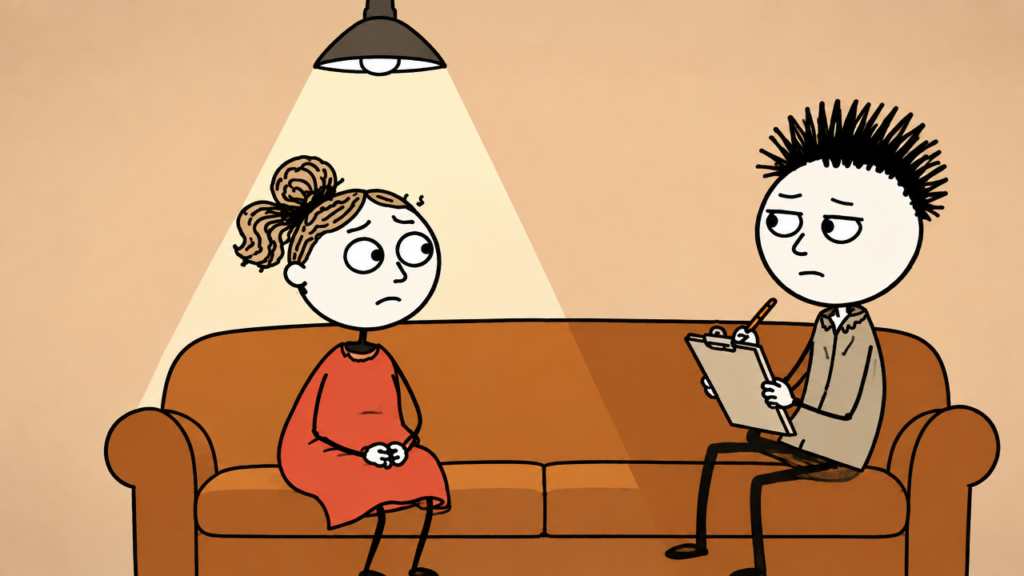
He doesn’t send hearts.
He doesn’t say “I miss you” at the end of every call.
But last week, out of nowhere, he asked where you see yourself in five years. Then he asked a follow-up question. And another.
Most people read that as cold. Like being interviewed instead of loved.
That’s the misread. For this type of man, the interview is the love letter.
An INTJ almost never tells you he sees a future with you. He shows you — in ways that are easy to miss entirely if you don’t know what you’re looking at.
Table of Contents
The seven signs, in short:
- He starts picking apart your plans
- He starts saying “we” about the far future
- He stops trying to impress you
- He can sit in silence with you for hours
- He stays in the argument instead of leaving
- He tells you why he’s like this
- He changes the plan for you
Here’s what each one looks like in real life, the psychology underneath it, and why it’s so easy to read as the opposite of what it is.
A quick note on language: we say “he” throughout, because this is the pattern we hear about most. INTJ women show every one of these signs too — often with even less social permission to be blunt or private about it. And a note on typology: MBTI describes patterns of preference, not a medical diagnosis. Treat it as a useful map, not a label.
The blueprint behind all seven
Before the list, it helps to understand what you’re actually dealing with.
Carl Jung described the mental process at the centre of this type. In the Myers-Briggs framework built on his work, the INTJ leads with introverted intuition — a mind that constantly builds models of how things will unfold — backed by extraverted thinking, a drive to test those models against reality and make them work.
For most people, the future is a daydream. Something pleasant you visit occasionally.
For an INTJ, the future is a working blueprint. He’s always running it, quietly, in the background: where this is going, what it costs, what it needs, what breaks it.
So the real question was never whether he has feelings for you. It’s whether you’ve been written into the blueprint.
Every sign below is a different way of finding out.
1. He starts picking apart your plans
You mention a job you’re thinking of taking. Instead of “that’s great,” you get questions. The commute. The salary. The manager’s track record. What happens in two years if the company gets bought.
It can feel like criticism. It usually isn’t.
Psychologist Arthur Aron spent decades studying what happens to the mind when two people grow close. He called the core of it including the other in the self. As a relationship deepens, the line between your problems and their problems genuinely blurs. In one well-known set of experiments, people in close relationships were measurably slower to sort their own traits from their partner’s — the boundary between two people was getting fuzzy at the level of reaction time.
For an INTJ, that shift has a very specific look. He doesn’t stress-test a stranger’s plans. He doesn’t care enough to. He stress-tests the plans of people whose failure would land on him as his own.
What it looks like: he asks the unglamorous question nobody else asked. He remembers the detail you mentioned once and brings it back three weeks later with a solution. He’s more interested in the thing that could go wrong than the thing that’s exciting.
Why it’s easy to misread: because it arrives in the shape of doubt. You wanted “go for it,” and you got a risk assessment. But he isn’t doubting you — he’s protecting something he has already started calling ours.
One honest caveat: there’s a difference between stress-testing and contempt. Stress-testing attacks the plan and leaves you intact: he pokes at the numbers, then helps you fix them. Contempt attacks you — your judgement, your intelligence, your taste. The first is a sign he’s invested. The second isn’t a personality type, it’s a problem, and no amount of typology makes it one of these seven.
2. He starts saying “we” about the far future
Not “we should grab dinner Friday.” Anyone says that.
This is “we” about three years from now. Where we’d live. What we’d do about money. How we’d handle the holidays. Said casually, almost absently, like it’s already settled.
Psychologist James Pennebaker built a career on the small words people barely notice — I, you, we. His central finding is that these throwaway function words reveal more about how people see a relationship than the big emotional vocabulary does. Researchers who followed that thread have found that couples who naturally use more “we” language tend to handle conflict better and report more satisfaction.
That matters more with an INTJ than with almost anyone else, for one reason: his mind doesn’t speculate for fun. When introverted intuition projects a future, it’s running a serious forecast. And he does not put things into a forecast he doesn’t expect to happen.
What it looks like: the pronoun shows up in logistics, not romance. Mortgages, holidays, where the dog would go, which city has better options for your career. The unsexiest sentences in the language, and every one of them assumes you’re still here.
Why it’s easy to misread: it’s so undramatic you can miss it completely. There’s no speech, no “I’ve been thinking about us.” He mentions a shared kitchen the way you’d mention the weather. If you’re waiting for a declaration, you’ll scroll right past the actual evidence.
If he’s saying “we” about years you haven’t lived yet, he isn’t dreaming out loud. He’s reading you the plan.
3. He stops trying to impress you
Early on, he was sharp. Precise. Always had the answer.
Now he lets you watch him be stuck. He shows you the idea that isn’t finished. He says, out loud, that he got something wrong.
Psychologists Irwin Altman and Dalmas Taylor described relationships as layers, like an onion — their social penetration theory. At first we share the outer layers, the polished version. Closeness means moving inward, toward the parts that are unfinished and uncertain.
For a lot of people, the innermost layer is emotion. For an INTJ, it’s incompetence. Being seen confused, wrong, or out of his depth is the most exposed he can feel. His coworkers never see it. Most of his family never sees it.
What it looks like: he thinks out loud in front of you instead of presenting conclusions. He asks what you think and actually waits. He’s visibly frustrated by a problem rather than quietly disappearing until he’s solved it.
Why it’s easy to misread: he seems less impressive than the man you met. Less polished, more irritable, more human. It’s easy to read as fading interest, or as him getting comfortable in the lazy sense.
It’s the opposite. He’s lowering the most important wall he has. He stopped performing for you because he stopped seeing you as an audience.
4. He can sit in silence with you for hours
You’re on the same couch. He’s reading. You’re doing your own thing. Nobody has said a word in an hour, and nothing about it is tense.
A lot of people take that as a bad sign. He’s bored. He’s distant. He’s not really here.
The psychoanalyst Donald Winnicott described this exact situation as a mark of genuine emotional maturity: the capacity to be alone in the presence of another. The ability to relax completely, fully yourself, while someone else is in the room. It develops out of safety. It doesn’t happen with people you’re still managing.
For an INTJ, solitude isn’t a preference, it’s infrastructure. It’s where he recharges and where he thinks. It’s the most protected space in his life.
What it looks like: he doesn’t entertain you, and he doesn’t need entertaining. He keeps working while you’re there. He falls asleep on the sofa mid-conversation. The social performance is simply switched off.
Why it’s easy to misread: every instinct says connection should sound like something. Silence reads as absence. But most people only ever get the polite version of him — the one who makes conversation and leaves early. You’re getting the one who stays.
If he used to disappear to be alone, and now he’s alone with you in the room, you’ve been moved from company to home.
5. He stays in the argument
To see why this one matters, you have to know what an INTJ usually does with conflict.
He doesn’t yell. He doesn’t slam doors. He quietly runs the numbers, decides the relationship costs more than it returns, and leaves. Often with no fight and no explanation — which is exactly why so many people describe being cut off by an INTJ as coming out of nowhere.
So when he stays, it’s information.
Psychologist John Gottman studied thousands of couples and found that stable ones still fight. What separates them is repair: the small attempts, during or after conflict, to reconnect. A joke. A touch. A quiet “can we try that again?” In his research, the ability to make and accept those repair attempts mattered more than how often couples argued, or even how badly.
What it looks like: he comes back to it. A day later, sometimes with notes. He wants to know what actually went wrong, and he wants it fixed rather than smoothed over. He’ll propose a rule so it doesn’t happen again, because that’s his love language and he knows no other way to say it.
Why it’s easy to misread: being revisited can feel like being relitigated. Most people want the fight to be over; he wants it solved. That can read as cold, even clinical, when it’s actually the most effortful thing he does.
Here’s the cost nobody sees. Emotional conflict drags an INTJ into the part of his mind he trusts least. Every repair costs him real energy. Leaving would genuinely be easier. He’s choosing the harder thing, deliberately, for you.
6. He tells you why he’s like this
At some point, usually late at night, he tells you something he has never said out loud. The house he grew up in. The teacher who made him feel strange. The first time he worked out that feelings were safer kept inside.
The psychiatrist John Bowlby, who founded attachment theory, called these early lessons internal working models — the blueprints children build about whether other people can be trusted, and whether being yourself is safe. We carry them into adult relationships mostly without noticing.
Plenty of INTJs built a model early that said: you’re too intense, too serious, too strange, keep it inside. So they did. For years. They learned to show up calm, capable and hard to read, because that felt safer than being known.
What it looks like: it’s rarely a dramatic confession. It’s one unguarded sentence dropped into an ordinary conversation, often while he’s driving or doing the dishes — somewhere he doesn’t have to make eye contact.
Why it’s easy to misread: you might not notice it happened. It can sound like a throwaway anecdote. But watch what he does next: he’ll check, subtly, what you did with it.
Those walls you ran into at the start were never about you. They were built long before you arrived. When he hands you the blueprint of them, he’s giving away the one thing he keeps for himself — the explanation. He wants you to understand him, because he’s planning on being understood by you for a very long time.
7. He changes the plan for you
This is the rarest one, and the clearest.
An INTJ’s long-term vision is the most defended thing he owns. He’s been building it for years. He has guarded it against friends, bosses, and family, and he’s been willing to lose people over it.
Then one day he rearranges it. He turns down the move. He reworks the timeline. He makes room. Sometimes it’s small — rebuilding his week around your schedule. Sometimes it’s a city, or a career.
Psychologist Caryl Rusbult spent her career studying why some people stay committed while others drift. One of the clearest behavioural markers she identified was willingness to sacrifice. Committed partners give up things they want for the relationship — and crucially, they don’t experience it as a loss. They experience it as investment in something shared.
What it looks like: he revises, and he doesn’t make a speech about it. No “look what I gave up for you.” The new plan simply has you in it, presented as though it were always that way.
Why it’s easy to misread: you may never learn what the original plan was. He won’t mention the job he didn’t apply for. The sacrifice is invisible by design, because announcing it would turn it into a debt, and he’s not interested in you owing him anything.
For an INTJ, the plan is identity. So when he changes it for you, don’t read it as giving something up. He hasn’t abandoned the blueprint. He’s redrawn it with two people in it — and for this type of man, that’s the most romantic thing he will ever do.
When it’s not this
Honesty matters more than flattery here, so: these signs only mean what they mean when they come together and hold over time.
A man who questions your plans but never shows up when you need him isn’t stress-testing a shared future — he’s just critical. A man who’s silent with you but silent on everything that matters isn’t offering you his solitude, he’s avoiding you. A man who says “we” about five years out while giving you nothing in the present is describing a fantasy, not a forecast.
The signs are a pattern, not a scoring system. If you’re reading this hoping to turn ambiguity into certainty about someone who has never actually chosen you, the pattern won’t do that job. The real version of this is unmistakable, and it’s consistent.
The short version
The next time an INTJ asks you a question that feels more like an interview than romance, you’ll know what you’re actually looking at.
A man who doesn’t say much, because for him words are cheap and plans are sacred. A man whose love shows up as questions, silence, repair, and a blueprint with room for you in it.
He’s not cold. He’s building something.
And if you’re in the plan, you’re in it for real.
Frequently asked questions
How do you know if an INTJ is serious about you?
Watch what he does with his future rather than what he says about his feelings. The clearest evidence is structural: he stress-tests your plans as if they were his own, uses “we” about years that haven’t happened yet, repairs conflict instead of leaving, and eventually rearranges his long-term plan to make room for you.
Why doesn’t an INTJ say how he feels?
Because he tends to trust evidence over declarations — including his own. Stating a feeling costs nothing and proves nothing, so he’d rather demonstrate commitment through planning, problem-solving and consistency. Many INTJs also genuinely struggle to put emotional experience into words quickly, which is a processing difference, not indifference.
Is an INTJ going quiet a bad sign?
Usually not. Comfortable silence with you in the room is a sign of trust. The warning sign is different in character: silence that’s cold and open-ended, with no explanation and no return — that’s typically how an INTJ exits, and it tends to follow a decision he’s already made privately.
Do INTJ women show the same signs?
Yes, all seven. The main difference is social rather than psychological: INTJ women often get even less permission to be blunt, private or uninterested in emotional performance, so the same signs can be buried further and misread as aloofness more often.
How long does it take an INTJ to commit?
Longer than most, and then more completely than most. He’s running a forecast, and forecasts need data — which means time and repeated behaviour. The slowness isn’t reluctance; it’s the same process that makes his eventual commitment so durable.