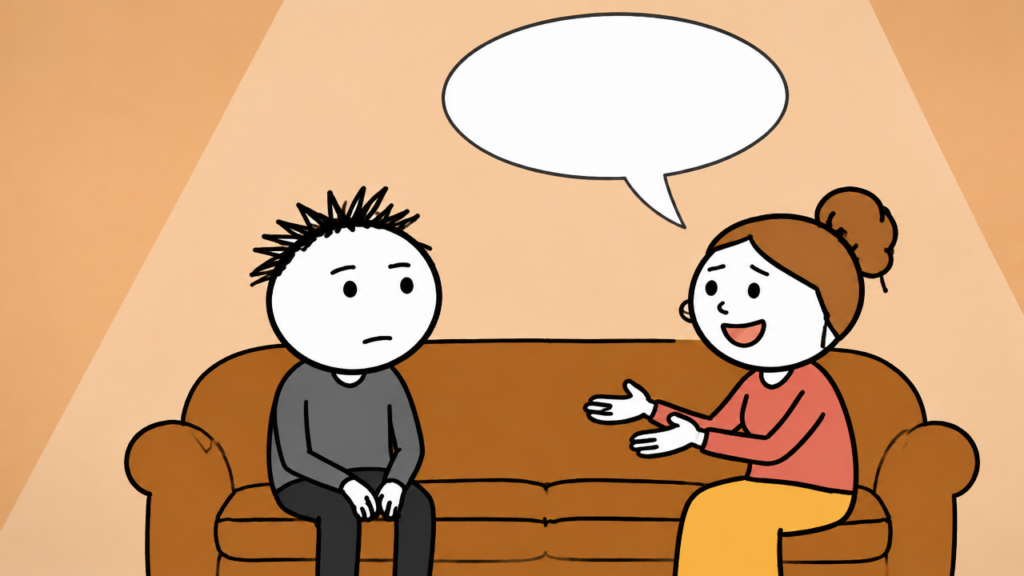
Ask an INTJ what he wants for his birthday, and he says nothing.
Ask him if he’s okay, and he says he’s fine.
Ask him what he needs from you, and he looks at you like the question doesn’t quite make sense.
Most people take that at face value. They call him low-maintenance. Self-sufficient. The easiest person in the room to take care of, because he never seems to need taking care of.
That’s the misread.
An INTJ has needs like everyone else. He just has a rule against asking. And the things he won’t ask for are exactly the things that decide whether he stays close to you — or quietly starts to pull away.
Table of Contents
The seven things an INTJ needs from you, in short:
- Honest disagreement, not agreement
- Space without being punished for taking it
- Plain words instead of hints
- His quiet acts of care recognised as care
- Permission to not be the capable one
- To be understood, not just liked
- You to stay — proven over time, not promised
Here’s what each one actually means, why he’ll never say it out loud, and what giving it looks like in real life.
A quick note on language: we say “he” throughout, because this is the pattern we hear about most. INTJ women carry every one of these needs too — often with even less social permission to show them. And a note on typology: MBTI describes patterns of preference, not a medical diagnosis. Treat it as a useful map, not a label.
Why an INTJ won’t just ask
Before the list, it helps to understand the engine underneath it.
Carl Jung described the mental process at the centre of this type. In the Myers-Briggs framework built on his work, the INTJ leads with introverted intuition — a mind that builds long-range models of how things will play out — and backs it up with extraverted thinking, a drive to make things work efficiently and independently.
That combination quietly treats asking for help as a design flaw. Needing something from another person registers as a dependency: a weak point in a system he would rather keep self-sufficient. So he builds a life that needs as little as possible.
But designing your needs away doesn’t delete them. It only hides them — and leaves the people who love him guessing.
1. He needs you to disagree with him
Not constantly. Not for sport. But honestly, out loud, when you think he’s wrong.
This sounds backwards. INTJs are confident, usually prepared, and good at arguing. So people nod along, because nodding is easier. But inside his head, a room full of agreement is a problem: his whole mind is built to test ideas against reality, and an idea nobody pushes against has never really been tested.
Psychologist Charlan Nemeth spent decades at UC Berkeley studying dissent. Her research found that when even one person genuinely disagrees, groups think more carefully — they search for more information, consider more options, and make better decisions. Strikingly, that holds even when the dissenter turns out to be wrong. The value is in the pushback itself.
Why he won’t ask: asking ruins it. “Please challenge me” turns real disagreement into a performance, and he wants to know what you actually think. There’s a second reason, too: he knows he can be intimidating. He’s watched people go quiet around him his whole life, and part of him has accepted that nobody’s going to argue with him anyway.
What giving it looks like: when he lays out a plan and something bothers you, say so, and give your reason. If he’s talking about moving cities for a new job, don’t bury your doubts to keep the peace — “I’m not sure the money makes up for the commute, and here’s why” is worth more to him than a week of agreement. He respects evidence far more than volume, so you don’t need to win. You just need to be honest.
2. He needs space without a penalty
Every INTJ has a limit on how much people he can take in a day. Even people he loves. When he hits it, he doesn’t get angry — he gets quiet, and he needs somewhere with a door.
The British psychologist Hans Eysenck proposed that introverts run at a higher baseline of cortical arousal than extraverts. Their nervous system is already turned up, so the same party pushes them past a comfortable level much faster. For an INTJ there’s a second layer: introverted intuition doesn’t work well in noise. It works in the background, in quiet, connecting dots nobody asked it to connect. Solitude isn’t where he escapes his life. It’s where he processes it.
Why he won’t ask: because “I need some time alone” lands on most people as “I need some time away from you.” They take it personally, go cold, ask what they did wrong. He learns that alone time has a price — and rather than pay it, he stops asking. He sits through the dinner, stays at the party, runs on empty. Then one day the battery is gone, he disappears for a week, and nobody understands why.
What giving it looks like: offer it before he has to ask. “You’ve had a long week — take tonight.” Then don’t make him pay for it when he comes back. No cold shoulder, no “oh, so now you want to talk?”
It also helps to tell space apart from withdrawal. Space is calm and temporary — he says he’s going, and he comes back. Withdrawal is cold and open-ended, and usually means something is wrong that he hasn’t said. Space needs your patience. Withdrawal needs a direct, gentle conversation.
What most people never find out is that an INTJ who’s allowed to leave comes back warmer and more present than he could ever be if he’d stayed. The space isn’t competing with you. It’s what makes his time with you worth having.
3. He needs you to say what you mean
This one surprises people, because an INTJ is genuinely perceptive. He can read the long game of a company, a market, a family. What he’s worst at reading is the thing right in front of him: a sigh, a tone, a “fine” that doesn’t mean fine.
The anthropologist Edward Hall gave us a useful distinction here: high-context versus low-context communication. High-context speakers put the meaning in tone, timing, and what’s left unsaid. Low-context speakers put the meaning in the words themselves. An INTJ is about as low-context as a person gets. His extraverted thinking takes words at face value, because that’s the efficient thing to do. When you say “I’m fine,” part of him files it as data.
Three hours later, he works out what you actually meant — and feels terrible that he missed it.
Why he won’t ask: needing things spelled out feels, to him, like a failure of intelligence. He believes he should be able to decode it. So he keeps guessing, keeps missing, and keeps quietly blaming himself.
What giving it looks like: say the actual thing. Not “do you think maybe we go to your mum’s a lot?” but “I’m tired of Sundays at your mum’s — can we do every other week?” Or: “I’m upset, and I don’t need a solution. I just need you to listen for ten minutes.”
This matters even more over text, where there’s no face or tone to work with. “K” reads as okay. If it isn’t okay, give him the real sentence — he’d far rather read two honest lines than decode one short one.
Being direct with an INTJ isn’t harsh. It turns his biggest blind spot into one of his biggest strengths, because he is genuinely excellent at meeting a need once he knows exactly what it is.
4. He needs you to see his care for what it is
An INTJ rarely says “I love you” the way people expect. He doesn’t do grand speeches, and he’s awkward with flowers. Tell him you had a terrible day, and his first move is to fix the thing that made it terrible.
The counsellor Gary Chapman popularised the idea that people express love in different “languages” — words, gifts, time, touch, and acts of service — and that we tend to give love in the language we’d most like to receive. An INTJ’s native language is almost always acts of service, with a cerebral accent: he researches your problem, remembers your plans, and builds a better way for your life to run.
The Myers-Briggs framework places introverted feeling third in the INTJ stack: deep, private values he rarely puts into words. The feeling is there, and it’s strong. It just comes out through his hands instead of his mouth.
When that goes unrecognised, something quietly breaks. She says, “you never tell me how you feel.” He hears, “everything you’ve been doing doesn’t count.” Because in his mind, he’s been telling you for months — every repair, every plan, every problem he made disappear before you noticed it.
Why he won’t ask: pointing at his own kindness would ruin it. Care that asks for credit isn’t care anymore. So he keeps giving, and keeps getting called cold.
What giving it looks like: name it, specifically. “I noticed you fixed the gate — thank you, that meant a lot.” “You remembered my dentist appointment. That’s the most romantic thing anyone’s done for me this month.”
One thing to avoid: don’t treat his way of caring as a failed version of yours. If every repair is met with “but why can’t you just say it,” he learns that his best effort doesn’t count. Accept his language first — the words come much easier after that.
5. He needs permission not to be the capable one
Most INTJs end up as the person everyone brings problems to. The friend who knows. The one who fixes it. The one who always has a plan. It works, because he’s good at it. But nobody asks the lighthouse how it’s holding up.
Psychologists Paul Hewitt and Gordon Flett have spent years studying perfectionism, including a form they call socially prescribed perfectionism — the belief that other people expect you to be flawless and will think less of you the moment you’re not. Their research links it to exhaustion, hidden anxiety, and a marked reluctance to ask for help. Because asking for help would show the crack.
For many INTJs, competence became identity early. They were the smart one, the mature one, the one who didn’t need much. People praised them for handling things — so handling things became the price of being valued.
Why he won’t ask: he genuinely doesn’t know how. And underneath it sits a quiet fear that if he stops being useful, he stops being wanted.
What giving it looks like: ask about him, not about the problem. “How are you actually doing with all this?” Then wait. The first answer will be “fine.” The second one might be real.
Make room for him to be ordinary, too. Let him be bad at bowling. Let him have no opinion about dinner. Let him make a wrong call without it becoming evidence — because when a mistake gets raised in every argument for a year, he learns that mistakes are permanent, and stops risking them at all.
And when he finally admits something is hard, don’t rush to fix it and don’t panic. Just stay close. The first time an INTJ puts the weight down in front of someone, he is watching very carefully to see what happens next.
6. He needs to be understood, not just liked
There’s a difference, and an INTJ feels it sharply. Plenty of people like him — he’s reliable, smart, good in a crisis. Very few have ever really understood how his mind works.
The psychologist Carl Rogers built his entire approach to therapy on this need. He argued that people grow when they feel deeply understood — when someone grasps their inner world without judging it. He called it empathic understanding. Rogers also described where the damage starts: conditions of worth, what happens when a child learns he’s only acceptable when he’s a certain way.
Now picture the young INTJ. The kid whose questions were too intense, whose interests were “too much,” who got told to stop overthinking and lighten up. He learned to edit himself — to give the short version, and to keep the big, strange, fascinating thoughts somewhere private where nobody could roll their eyes at them.
As an adult, he gives most people the edited version. It’s easier and safer. And it’s lonely in a way he’d never describe as lonely.
Why he won’t ask: he learned long ago that asking is how you get disappointed. If he asks you to understand and you don’t, that confirms the story he’s told himself since childhood.
What giving it looks like: ask about the thing he’s into — and then ask a second question. The second question is the one that matters, because it proves you weren’t just being polite. Let him go on a tangent without checking your phone. Don’t call it a lecture. And if you don’t follow something, say so and ask him to walk you through it; confusion that asks questions reads as interest. It’s the polite nod with nothing behind it that he writes off.
Better still, bring him something: an article on the subject he won’t stop talking about, or a question you thought of on the drive home. For an INTJ, evidence that his inner world has been living in your head too is closer to romance than roses.
7. He needs you to stay
Not to prove it with words. To prove it with time — especially in the moment he finally shows you the part of himself he doesn’t show anyone.
Every INTJ has a moment like that eventually. The calm, logical man gets overwhelmed. He says something raw, admits a fear, or his feelings arrive clumsy and bigger than he expected.
The psychiatrist John Bowlby, who founded attachment theory, described what we need from the people closest to us as a secure base: someone steady you can venture out from and return to, knowing they’ll still be there. For most people, reassurance arrives through words. For an INTJ, it arrives through evidence. He doesn’t believe what you say you’ll do; he believes what you’ve done, repeatedly, over time.
That’s why the moment after he opens up matters so much. If you flinch, pull back, or use it against him later, he’ll close that door for years.
Why he won’t ask: asking you to stay would mean admitting how much it would hurt if you didn’t. He’d rather be alone than depend on something he can’t predict.
What giving it looks like: when he shows you something real, don’t make it a scene — and don’t pull away either. Stay in the room. Meet rare honesty with steadiness. Then keep showing up the same way next week, and the week after.
Consistency does more here than intensity. One huge romantic gesture won’t reassure him; a hundred small reliable ones will. The text you sent when you said you would. The plan you kept. The secret of his you never repeated. That’s the proof.
And here’s the strength underneath all seven needs: once an INTJ decides you’re safe, his loyalty is close to absolute. He’ll defend you in rooms you’re not in. He’ll plan for your future as seriously as his own. He’ll bring that entire strategic, relentless mind to the job of taking care of you — not because he has to, but because he chose you, deliberately, after years of choosing no one.
That kind of loyalty isn’t handed out. It’s earned. And the price of earning it is simple, even when it isn’t easy. Stay.
The short version
So the next time an INTJ tells you he’s fine and doesn’t need anything, you know what you’re actually looking at.
Someone who needs honesty, space, and plain words. Someone who needs his quiet care noticed, permission to be ordinary, and his mind taken seriously. And someone who needs you to stay.
He’ll never ask for any of it. But he’ll notice every single time you give it.
Frequently asked questions
Why won’t an INTJ just tell you what he needs?
Because the INTJ’s dominant mental pattern treats dependency as a design flaw. Asking for something feels like exposing a weak point, so he engineers his life to need as little as possible — and assumes that anything truly important would be obvious to someone paying attention.
Does an INTJ pulling away mean he’s losing interest?
Not usually. Withdrawal for recovery is normal and temporary: he says he’s going, and he comes back. The warning sign is withdrawal that’s cold and open-ended with no explanation — that generally means something is wrong he hasn’t said yet.
How do you show love to an INTJ?
Be direct, be consistent, and take his thinking seriously. Say what you mean instead of hinting, recognise practical help as affection, and give him room to be alone without a penalty when he comes back.
Do INTJ women need the same things?
Yes — all seven apply. The main difference is social: INTJ women are often given even less permission to be blunt, private, or uninterested in emotional performance, so the needs tend to be hidden further.